


Market Insight- Global Face Recognition Access Control Terminal Market Overview 2026
Global Face Recognition Access Control Terminal Market Was Valued at USD 2.003 billion in 2025 and is Expected to Reach USD 4.603 billion by the End of 2035, Growing at a CAGR of 8.68% Between 2025 and 2035.– Bossonresearch.com
A face recognition access control terminal is a dedicated device that captures a facial image, converts it into a biometric template and matches that template against an enrolled database before releasing a door, gate or turnstile. The hardware combines a visible-light image sensor with a near-infrared illumination and filter pair, an embedded processor running liveness detection and feature extraction, an encrypted local template store and an interface layer that connects to access controllers, video management platforms and building management systems. Commercial value rests less on the recognition algorithm than on the reliability of the verification event: the false acceptance and false rejection rates, the response latency under poor light, the resistance to photograph and video spoofing, and the cost of integrating the device with credentials and controllers already installed in the building.

Global revenue rose from USD 1,561.44 million in 2020 to USD 1,903.65 million in 2024 and USD 2,002.64 million in 2025, a compound annual rate of 5.10% across the five-year window, with a single interruption in 2022 when revenue fell to USD 1,739.94 million as commercial construction slowed. Shipments reached 10.825 million units in 2025 and are forecast at 28.448 million units in 2035. Revenue expands at 8.68% a year between 2025 and 2035 to USD 4,602.55 million, an absolute addition of USD 2,599.91 million. Because unit growth of 10.14% a year outpaces revenue growth, average selling price falls from roughly USD 185 per terminal in 2025 to USD 162 in 2035, a 1.3% annual erosion that reflects component cost deflation and the migration of volume toward lower-priced residential devices.
Growth is constrained less by demand than by the terms on which demand is served. Recognition performance degrades under strong backlight, sidelight, face coverings and low-temperature outdoor installation, and each increment of accuracy is purchased with sensor cost or processing headroom. Biometric data collection is regulated differently across jurisdictions: personal information rules in China require separate consent for facial data, the European Union treats facial templates as special-category data, and several United States jurisdictions impose notice and retention limits, so a single hardware configuration rarely clears compliance in every market. Standardised terminals compete mainly on price, lead time and interface compatibility, while RFID cards, mobile credentials, PIN pads and fingerprint readers remain adequate substitutes in low-security settings, which caps the premium that face recognition can sustain.
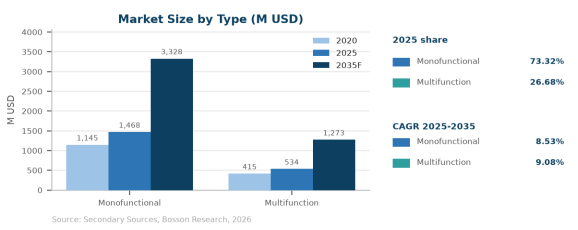
The market divides into monofunctional and multifunctional terminals, and the split is wide. Monofunctional devices, which perform face verification as their primary and often only credential, generated USD 1,468.44 million in 2025, or 73.32% of global revenue, and are forecast to reach USD 3,328.63 million in 2035 at 8.53% a year. Multifunctional terminals, which combine face recognition with fingerprint, card, QR code, PIN or intercom functions in one enclosure, generated USD 534.21 million, or 26.68%, and grow faster at 9.08% to USD 1,273.92 million. Monofunctional devices hold the volume base in residential and rental-housing deployments where a single credential is sufficient and unit cost governs the purchase; multifunctional devices win in offices, schools and transport nodes where a mixed population of users and legacy credentials must be accommodated.
Table 1 Global face recognition access control terminal market by type, 2025 and 2035F (M USD)
|
Segment |
2025 |
2035F |
Share 2025 |
CAGR 25-35 |
|
Monofunctional |
1,468 |
3,329 |
73.32% |
8.53% |
|
Multifunction |
534 |
1,274 |
26.68% |
9.08% |
|
Total |
2,003 |
4,603 |
100.00% |
8.68% |
Source: Bosson Research analysis, 2026.
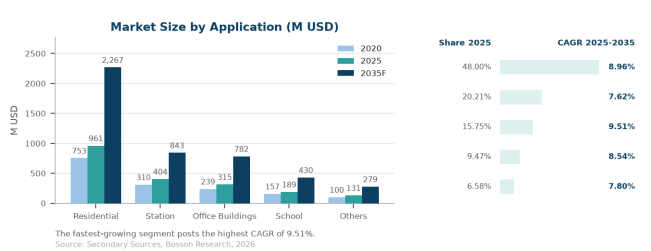
Residential use is the largest application, at USD 961.22 million and 48.00% of 2025 revenue, and is forecast to add USD 1,306.32 million by 2035 to reach USD 2,267.54 million at 8.96% a year. The segment's weight follows from the installed base of apartment buildings, rental housing and self-built homes in Asia-Pacific, where facial access has become part of the standard package for new residential projects rather than an optional upgrade. Stations generated USD 404.72 million, or 20.21%, but grow slowest among the tracked segments at 7.62%, because rail and metro projects are procured in discrete capital cycles tied to line openings. Office buildings, at USD 315.37 million and 15.75%, post the fastest rate at 9.51% as commercial landlords retrofit card systems to support touchless entry and tenant analytics. Schools contributed USD 189.62 million at 8.54%, and the residual category USD 131.71 million at 7.80%.
Table 2 Global face recognition access control terminal market by application, 2025 and 2035F (M USD)
|
Application |
2025 |
2035F |
Share 2025 |
CAGR 25-35 |
|
Residential |
961 |
2,268 |
48.00% |
8.96% |
|
Station |
405 |
843 |
20.21% |
7.62% |
|
Office Buildings |
315 |
783 |
15.75% |
9.51% |
|
School |
190 |
430 |
9.47% |
8.54% |
|
Others |
132 |
279 |
6.58% |
7.80% |
|
Total |
2,003 |
4,603 |
100.00% |
8.68% |
Source: Bosson Research analysis, 2026.
Asia-Pacific generated USD 913.14 million in 2025, or 45.60% of global revenue, and is forecast to reach USD 2,070.93 million by 2035, an addition of USD 1,157.79 million at 8.53% a year. The region's position rests on residential construction volumes in China, the density of manufacturing and campus sites, and a domestic supply chain that spans image sensors, algorithm development and terminal assembly within a short logistics radius. North America, at USD 595.94 million and 29.76%, grows faster at 9.60% and adds USD 895.15 million, driven by replacement of legacy card readers in commercial real estate and by compliance-led upgrades in healthcare and education. Europe holds USD 384.09 million, or 19.18%, but expands at 6.93%, the slowest of the five regions, reflecting consent-related deployment friction and a slower commercial retrofit cycle. South America and the Middle East and Africa remain small at USD 57.03 million and USD 52.45 million, or 2.85% and 2.62%, yet post the highest growth rates at 11.19% and 9.10% from a low base.
Table 3 Global face recognition access control terminal market by region, 2025 and 2035F (M USD)
|
Region |
2025 |
2035F |
Share 2025 |
CAGR 25-35 |
|
Asia-Pacific |
913 |
2,071 |
45.60% |
8.53% |
|
North America |
596 |
1,491 |
29.76% |
9.60% |
|
Europe |
384 |
750 |
19.18% |
6.93% |
|
South America |
57 |
165 |
2.85% |
11.19% |
|
Middle East and Africa |
52 |
125 |
2.62% |
9.10% |
|
Total |
2,003 |
4,603 |
100.00% |
8.68% |
Source: Bosson Research analysis, 2026.
Face Recognition Access Control Terminal Industry Chain Analysis
Hardware Architecture and Recognition Pipeline
Monofunctional Terminals: Single-Credential Economics
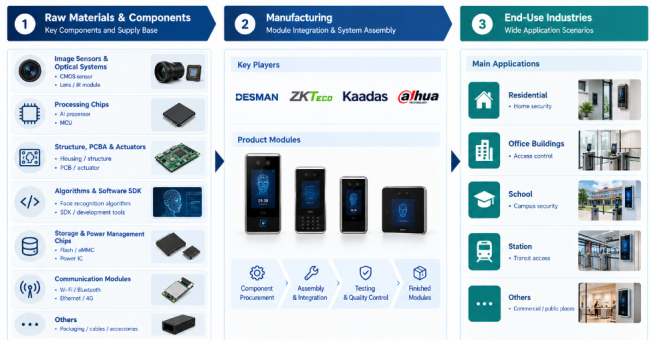
A monofunctional terminal is built around a narrow bill of materials: a visible-light image sensor, a near-infrared emitter and filter pair that supplies illumination-invariant imagery for liveness checks, an application processor with an embedded neural inference engine, a local template database held in encrypted flash, and a relay or Wiegand and OSDP interface to the door controller. Recognition is performed on the device, and network connectivity is needed only for enrolment synchronisation and event logging. This architecture keeps unit cost low and allows operation during network outages, which matters in residential buildings where the terminal must open a door even when the building network is down.
Cost structure is dominated by the sensor and illumination pair and by the processor. At an average selling price of roughly USD 185 per terminal in 2025, the bill of materials leaves limited headroom for algorithm licensing, which is why the segment has consolidated around suppliers that own both the recognition algorithm and the assembly line. Vendors that license a third-party algorithm carry a per-unit royalty that is difficult to absorb at residential price points, whereas vertically integrated suppliers amortise algorithm development across volumes that reached 10.825 million units in 2025.
Performance is bounded by the recognition pipeline rather than by the display or the enclosure. Recognition distance, tolerance of yaw and pitch, and the ability to reject printed photographs, replayed video and silicone masks determine whether a terminal can be installed outdoors or must sit under a canopy with controlled light. Devices rated at 0.3 to 0.5 second recognition and 100,000-template capacity now appear in mainstream products, and the binding constraint has shifted from algorithm accuracy to the cost of the infrared and depth-sensing components needed to hold accuracy in uncontrolled light.
Deployment runs through three channels with different purchasing logic. Property developers specify terminals at the construction stage, and the decision is made by the developer's engineering team on price and on compatibility with the building intercom and lift control. Rental operators and property management companies procure on a replacement basis and weight remote management and enrolment throughput more heavily than unit price. System integrators serve office, school and station projects, where the terminal is one line item in a security package and interoperability with video management and intrusion systems displaces cost as the deciding criterion.
Multifunctional Terminals: Consolidating Credentials
The multifunctional segment trades unit cost for coverage of a mixed user population. A single enclosure carries a face camera alongside a fingerprint sensor, an RFID reader, a QR code scanner, a PIN pad and in some designs a video intercom, and the device selects or combines credentials according to policy. This matters where the enrolled population is heterogeneous: a school must serve staff, students and visitors; an office building must accommodate tenants who still hold legacy cards; a station must process occasional travellers with no prior enrolment. The segment generated USD 534.21 million in 2025 and grows at 9.08% a year, faster than the monofunctional segment's 8.53%, because each retrofit that consolidates two or three separate devices into one enclosure converts monofunctional demand into multifunctional demand.

Development Trends
This is also where competition from adjacent categories enters. Video intercom manufacturers, lock makers and smart-home platform providers are converging on the same enclosure, and several recent product launches combine facial access with intercom, temperature screening or voice assistance. The competitive boundary of the multifunctional segment is therefore not other access control vendors but the wider set of firms that already own the door, the network or the tenant relationship.
Software, not hardware, carries the differentiation. Multifunctional terminals are sold with enrolment tools, access rule engines, attendance modules and APIs for building management and human resource systems, and the recurring software and support revenue is what makes the segment's gross margin more durable than the monofunctional segment's. The device becomes the endpoint of a management platform, and the platform's compatibility with existing controllers determines whether a retrofit proceeds building by building or portfolio by portfolio.
The engineering constraint is thermal and computational rather than optical. Adding fingerprint and card readers to a face terminal raises the idle power draw and the heat that must be dissipated from a sealed wall-mounted enclosure, and the processor must schedule face inference, fingerprint matching and network traffic without queueing delays at peak entry times. Suppliers that integrate multiple modalities therefore design around a shared compute platform rather than adding modules to a monofunctional board, and the resulting firmware complexity is a barrier that favours established vendors.
From Hardware Specification to Scenario Intelligence
Competitive emphasis has moved from camera resolution and recognition distance to the ability to serve a specific scenario. A residential terminal is judged on enrolment speed for older residents, tolerance of poor corridor lighting and integration with lift control; a station terminal is judged on throughput per gate and on the ability to process unenrolled visitors without a staffed counter. Vendors that publish one specification sheet across all scenarios lose tenders to vendors that ship scenario-specific firmware, and the catalogue has correspondingly fragmented into residential, commercial, transit and industrial lines built on shared hardware platforms.
Multimodal sensing is the second shift. Visible-light imaging alone cannot separate a live face from a high-resolution photograph or a replay on a tablet, and the countermeasure is to add near-infrared imaging, structured-light or time-of-flight depth sensing and in some designs a thermal channel. The sensors are coordinated rather than redundant: near-infrared supplies illumination-invariant texture, depth supplies three-dimensional structure, and the visible channel supplies the image quality needed for enrolment and for human review of denied attempts. The cost of this sensor stack is the main reason multifunctional and outdoor-rated terminals carry a price premium over indoor monofunctional devices.
The third shift is the migration of verification from a central server to the terminal and back to the cloud, with the functions cleanly divided. Early architectures streamed images to a server for matching, which concentrated compute but exposed the network to biometric data in transit. On-device inference removes that exposure and permits offline operation, and the current generation performs detection, liveness assessment, feature extraction and matching locally while using the network only for template synchronisation. Cloud platforms retain management, enrolment and audit functions, which is where the recurring revenue sits.
Residential Retrofits Set the Pace of Volume Growth
The largest source of incremental volume is not new commercial construction but the retrofit of existing residential buildings. In China, the redevelopment of older urban neighbourhoods and the spread of managed rental housing have converted facial access from a premium feature into part of the building's operating infrastructure, and property managers value the terminal because it removes the cost of issuing and replacing physical keys and because entry records support dispute resolution. Similar dynamics appear in Southeast Asian condominium markets, where facial access is marketed as a building amenity.
Retrofit economics differ from new-build economics. A new-build project specifies the terminal before door hardware is ordered and can standardise on one model across hundreds of units; a retrofit must work with the existing lock, the existing intercom and the existing network, and must be installed without disrupting residents. This favours terminals with wide interface support, including Wiegand, OSDP, relay, Ethernet and Wi-Fi, over terminals optimised purely for recognition accuracy, and it explains why the installed base of controllers constrains the pace at which the market converts.
Privacy regulation shapes the retrofit path more than it shapes the hardware. Jurisdictions that require separate consent for facial data, or that restrict its use in publicly accessible accommodation, push deployments toward alternatives such as mobile credentials or card-plus-PIN, and vendors respond by shipping terminals that can operate in face-only, face-plus-card or card-only modes. The ability to switch modality without replacing hardware has become a procurement requirement in multinational property portfolios, and it is one reason multifunctional terminals grow faster than the market average.
Customer preferences are also recalibrating: authenticity is becoming a decisive driver of demand, with a large share of global consumers willing to pay a premium for locally sourced, higher-quality options, pushing producers toward more experiential and culturally resonant solutions.
Access Management Becomes Recurring Infrastructure
Demand from enterprises and public facilities has shifted from project-based procurement to recurring expenditure. Once a building's access system is networked, the terminal becomes a node that must be refreshed on a replacement cycle, integrated with visitor management and attendance systems, and supported under a service contract. This converts a discretionary capital purchase into an operating line and stabilises volume through construction cycles. The installed base also generates the data, including entry counts, occupancy patterns and denied attempts, that justifies further spending on analytics and integration.
Contactless access has moved from a hygiene preference to an expectation. The change is visible in commercial real estate, where touchless entry is now specified alongside lift dispatch and lighting control, and in healthcare and education, where shared surfaces are treated as an infection-control risk. Face recognition is the only mainstream credential that asks nothing of the user beyond approaching the door, and that property rather than accuracy is what makes it the default choice at high-traffic, low-friction entry points.
Physical security requirements add a second layer of demand. Data centres, laboratories, industrial sites and restricted areas within office buildings need to separate authorised from unauthorised entry with an audit trail, and face recognition supplies an identity record that cards cannot, because a card can be lent or shared. As operational technology networks converge with information technology networks, the access terminal also becomes a control point whose logs feed security information and event management systems, which raises both the specification and the replacement value of the device.
Component Cost Deflation Widens the Price Band
The supply-side driver most often underestimated is the fall in the cost of edge inference. A recognition pipeline that required a dedicated digital signal processor and a separate algorithm licence a decade ago now runs on a general-purpose application processor with an integrated neural engine, and image sensors with adequate low-light performance have migrated from security-specific supply to consumer supply. The effect is not uniform price reduction but a widening of the price band: terminals now reach rental housing, small offices and school gates that were previously served by cards and PIN pads alone.
Component availability shapes the price band as much as component cost does. Image sensors, infrared emitters and memory are shared with smartphones, automotive cameras and consumer electronics, and allocation during periods of shortage moves against lower-volume security customers. Vendors with long-term supply agreements and multi-source qualification preserve delivery during those periods, and delivery reliability becomes a competitive attribute in tenders where the terminal sits on the critical path of a building handover.
Policy support operates through building standards rather than direct subsidy. Requirements for smart community infrastructure in China, fire and life-safety codes that specify controlled egress in commercial buildings, and public-sector procurement rules that favour domestically manufactured security equipment all widen the addressable base without naming face recognition. The technology is pulled in as a means of meeting a building-performance requirement, which makes demand less sensitive to the technology's own publicity than a consumer market would be.
Recognition Accuracy Is No Longer the Binding Constraint
The technical constraint has moved from the algorithm to the deployment environment. Recognition accuracy measured on benchmark datasets has been high enough for commercial use since the late 2010s, and the remaining error modes are environmental: backlight from a glass entrance, strong sidelight in a corridor, low temperature at an outdoor gate, masks and helmets that occlude the lower face, and users who do not stop moving. Vendors now compete on the size of the operating envelope, meaning the range of illumination, distance, pose and approach speed within which the false rejection rate stays acceptable, rather than on peak accuracy.
Liveness detection has become the dividing line between consumer-grade and security-grade devices. A printed photograph defeats a camera-only terminal; a replay on a tablet defeats a system that checks only for motion; a silicone mask defeats systems that rely on a single infrared channel. The countermeasure is a coordinated sensor set with a presentation-attack-detection model trained against known spoof types, and the cost of that sensor set is what separates a residential terminal from a terminal rated for a data centre or a border checkpoint.
The practical consequence is that hardware differentiation is converging while software differentiation widens. Two terminals built from the same sensor and processor reference design can differ by an order of magnitude in false rejection rate under adverse light, because the difference lies in the tuning of the detection pipeline and in the quality controls applied at enrolment. This shifts value toward vendors that control their algorithm stack and away from assemblers that buy a complete module and a licence.
Global Face Recognition Access Control Terminal Market: Competitive Landscape
None of these drivers removes the constraint that access control is a system sale. A terminal that recognises faces perfectly but cannot be enrolled at scale, audited for compliance or integrated with the building's controllers will lose to a less accurate device that can. The purchase decision is made jointly by facilities, security and information technology functions, and the terminal is evaluated as one component of an operating system rather than as a standalone product.
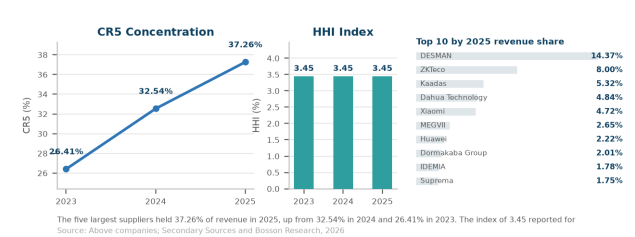
The competitive structure is best described as concentrating at the top and fragmented below. The five largest suppliers held 37.26% of revenue in 2025, up from 32.54% in 2024 and 26.41% in 2023, and the increase is almost entirely attributable to one firm. DESMAN raised its share from 7.80% in 2023 to 14.37% in 2025, adding USD 145.44 million of revenue in two years while the next four leaders grew far more slowly. ZKTeco held 8.00%, broadly flat since 2020; Kaadas rose from 1.28% to 5.32% on the strength of the residential lock channel; Dahua Technology slipped from 5.69% to 4.84%; and Xiaomi reached 4.72% from 3.26%.
Table 4 Global face recognition access control terminal market concentration, 2025 (revenue share and HHI)
|
Company |
2023 |
2024 |
2025 |
Type |
|
DESMAN |
7.80% |
12.61% |
14.37% |
Tier 1 |
|
ZKTeco |
8.38% |
7.99% |
8.00% |
Tier 1 |
|
Kaadas |
1.28% |
2.37% |
5.32% |
Tier 1 |
|
Dahua Technology |
5.69% |
5.46% |
4.84% |
Tier 2 |
|
Xiaomi |
3.26% |
4.10% |
4.72% |
Tier 2 |
|
MEGVII |
3.45% |
3.15% |
2.65% |
Tier 2 |
|
Huawei |
1.16% |
1.68% |
2.22% |
Tier 2 |
|
CR5 |
26.41% |
32.54% |
37.26% |
Top five |
|
HHI |
- |
- |
3.45 |
Top-five index |
Source: Bosson Research analysis, 2026.
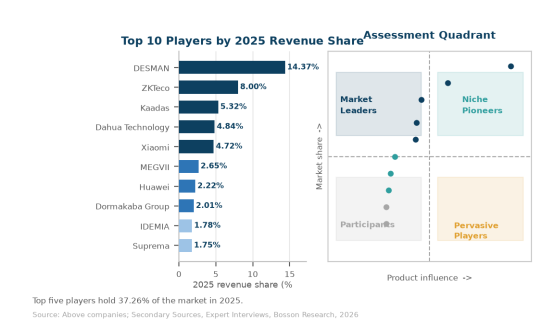
Key players in the Face Recognition Access Control Terminal Market include:
ZKTeco
Kaadas
Dahua Technology
Xiaomi
MEGVII
Huawei
Dormakaba Group
IDEMIA
Request for more information
Click to view the full report TOC, figure and tables: https://www.bossonresearch.com/yjbg
About US:
Bosson Research (BSR) is a leading market research and consulting company, provides market intelligence, advisory service and market research reports for the automobile, electronics and semiconductor, and consumer good industry. The company assists its clients to strategize business policies and achieve sustainable growth in their respective market domain.
Bosson Research provides one-stop solution right from data collection to investment advice. The analysts at Bosson Research (BSR) dig out factors that help clients understand the significance and impact of market dynamics. Bosson Research (BSR) bring together the deepest intelligence across the widest set of capital-intensive industries and markets. By connecting data across variables, our analysts and industry specialists present our customers with a richer, highly integrated view of their world.
Contact US:
Tel: +86 400-166-9288
E-mail: sales@bossonresearch.com
